Insurance policy checking: an agency checklist
Check an issued commercial policy against the accepted terms, record discrepancies and follow corrections through to the revised documents. A checklist for US agency teams.
Insurance policy checking is the review of the policy that was actually issued, not just the offer the client accepted. For a US commercial lines agency, the task is to reconcile issued documents with the placement record, identify discrepancies and follow the required corrections until the file contains the right documents.
This checklist starts after placement. It does not repeat a renewal plan or a quote comparison. Those earlier steps establish what the client selected; the issued-policy check asks whether the documents accurately reflect that selection, including the schedules and endorsements that a declaration page cannot explain.
Assemble the documents before starting
Keep the accepted quote and any revisions, client instructions, binding request and carrier confirmation together with the issued policy. Include relevant applications, schedules and written clarifications. For a renewal, the expiring policy may also be needed to investigate a change. Identify the version and date of each item rather than comparing an old quote with a revised placement.
Retain the reviewed application as a dated source in the placement record. The ACORD preparation checklist explains how to distinguish confirmed answers from unresolved information before the file is submitted.
A binder, quotation and policy are different documents. Do not assume their wording is interchangeable or that a requested item was accepted merely because it appears in an email. If the issued file is incomplete, ask for the missing part and record that the review is not finished.
The Big I's June 13, 2025 guidance on preventing common agency E&O claims recommends reviewing new and renewal policies and documenting relevant client communications. The checklist below organizes that work; it does not guarantee protection against an E&O claim.
The issued-policy checking checklist
1. Identity, dates and covered operations
Check the named insured and the relevant entities against the accepted placement. Confirm mailing and risk addresses, policy period and schedules. Investigate an omitted location, a different legal entity or an operation description that no longer matches the submitted risk. Do not change an entity's treatment based only on similar names.
2. Limits, deductibles and valuation
Compare the applicable limits, sublimits, aggregates, deductibles and retentions with the accepted terms. For property, inspect the applicable valuation basis and relevant schedules; for liability, inspect the basis and structure of the limits. Record units and whether a value applies per occurrence, per claim, per location or in aggregate where relevant.
3. Forms, endorsements and exclusions
Reconcile the endorsement schedule with the actual documents provided. Check whether requested endorsements were included, whether an unexpected exclusion appeared and whether an edition changed. Similar titles do not establish identical wording. When a requested status depends on an endorsement, locate that endorsement and review its applicable conditions.
4. Line-specific conditions
Apply the agency's specialist checks for the line. Examples include relevant auto symbols and vehicle schedules, property conditions and protective safeguards, or retroactive dates and reporting provisions for claims-made coverage. This general checklist is not a substitute for those line-specific procedures. Refer unfamiliar wording to the appropriate qualified reviewer.
5. Premium and payment information
Reconcile the premium and documented charges with the final placement record. Separate a billing difference from a coverage difference. Check the relevant payment arrangements and audit provisions without assuming that an estimated premium is necessarily a fixed final amount. Route unresolved billing questions to the person responsible for that part of the account.
6. Open requirements
Record outstanding documents, signatures or other carrier requirements together with the source and responsible person. A policy appearing in the AMS does not prove every placement requirement has been resolved. Confirm the action required and its actual due date rather than inventing a standard deadline for all accounts.
Use a discrepancy log, not a second summary
The useful output is a short record of each unresolved difference. Use these fields: policy and version; item checked; expected value or wording with its source; issued value or wording with its source; question or requested correction; owner; date raised; next follow-up; and evidence of resolution. Keep links or references to the source documents.
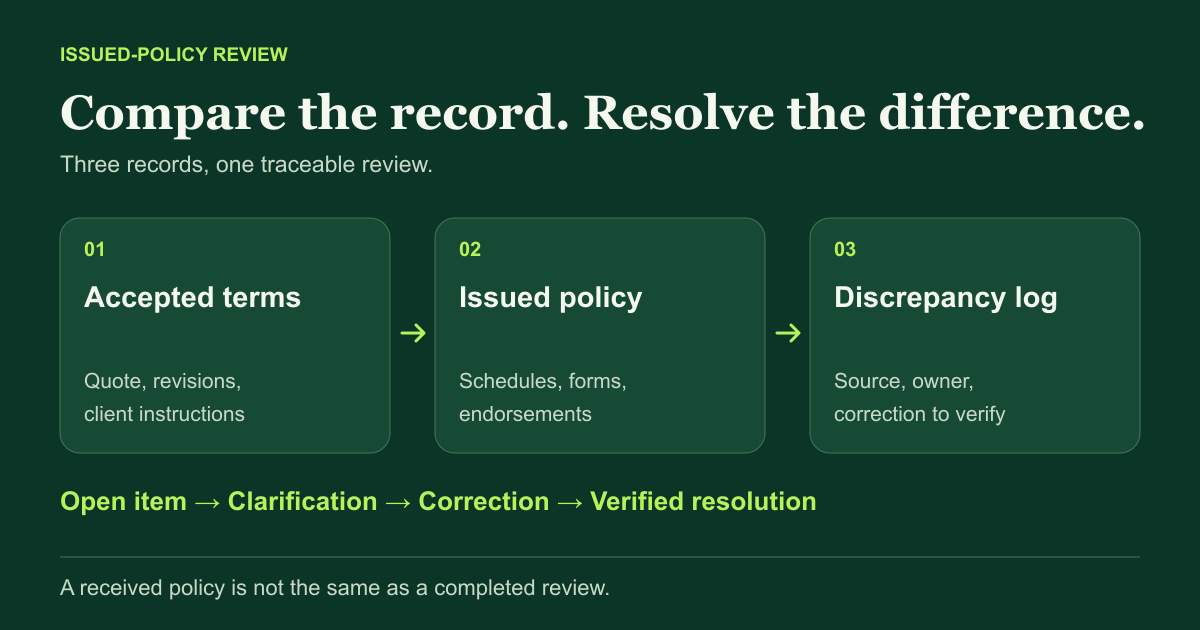
Illustrative example: the accepted placement lists two insured locations, but the received schedule contains only one. Record the omitted location and both document references, ask the carrier to confirm the treatment and request the appropriate correction. Do not silently amend the agency's copy and treat that edit as an insurer-issued change.
Mark each item as open, awaiting clarification, correction requested or verified resolved. Acknowledgement of your email is not necessarily confirmation that the documents have been corrected. If the carrier explains that a difference is intentional, the responsible professional still needs to assess it and decide what to communicate to the client.
A correction request to adapt
Subject: Issued document review, [insured / policy number]
We are reviewing the issued [document and version] against the accepted placement dated [date]. The accepted [quote / written confirmation] shows [expected item]. The issued [page / schedule / endorsement] shows [different item]. Please confirm whether this is an issuance discrepancy and provide the appropriate clarification or revised document.
Our file references are [document references]. The agency contact for this item is [name]. Please also confirm any action required from the insured while the item is being reviewed.
Replace the bracketed fields and describe the difference precisely. Do not label every difference an error before the carrier has explained it, and do not promise a retroactive correction to the client. Keep the request and response in the account record.
Close the loop on corrected documents
When revised documents arrive, check the correction and any related changes, then update the discrepancy log. Keep the earlier version in the appropriate history so another employee can understand the sequence. The responsible team member should decide whether the client needs updated documents or an explanation.
A useful measurement is the number and age of unresolved discrepancies, not only policies checked per hour. Track files that cannot be reviewed because documents are missing, repeat issuance issues and items reopened after an apparent correction. Fast review does not help if the follow-up is left unfinished.
For the earlier offer-review stage, use our guide to comparing insurance quotes with AI. Keep quote comparison and issued-policy checking as distinct steps in the procedure.
Where AI can help, and where its scope ends
AI can assist with extracting values and organizing differences, but an extraction needs to be checked against the source. A blank field is not evidence of absent coverage, and a high confidence score does not settle policy interpretation. Your reviewer must evaluate the wording and the placement record together.
Keep the issued-policy review separate from the overall commercial renewal checklist. Give each discrepancy its own owner and follow-up date rather than closing the renewal file as soon as documents arrive.
Frequently asked questions
What is insurance policy checking?
Policy checking is the review of issued documents against the accepted terms, placement instructions and relevant records. It is different from comparing competing quotes before a client chooses an offer.
Is checking the declaration page enough?
No. Endorsements, schedules, exclusions and conditions can change how coverage works even when the declaration page looks correct. Review the relevant policy documents, not only the summary.
Does a policy checking checklist prevent E&O claims?
No checklist guarantees protection against an E&O claim. A documented review can help identify discrepancies and show what the agency did, but it does not replace professional judgment.
How can an agency test a policy checking tool?
Use a file with known discrepancies and compare the output with the source documents. Check omitted endorsements, changed wording and unresolved questions, then assess whether the reviewer can locate and verify each finding.